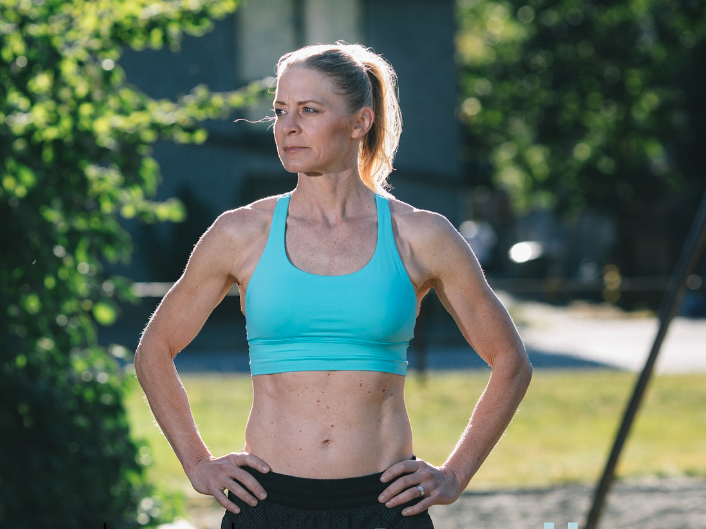
Strengthening this “red zone” is one of the keys to improving your performance and remaining injury-free for every sport. Your power comes from the core.
These muscles stabilize your torso and provide the base on which you can build power and strength. It doesn’t help to have strong legs if you have a weak core.
Twice a year I offer an AB CHALLENGE series and I hope you will join me. I need to clarify that this challenge focuses purely on ABS; however, it is imperative that you use your core to complete the exercises.
In my workouts, I talk about the pelvic floor. Contracting the core is not the same as holding your breath or sucking in your belly. Both of these actions are dangerous when strength training as they increase intra-abdominal pressure, which is not good.
Check with yourself. Do you know how to hold your core? If not, please repeat this glute and core maintenance video once a week until you feel comfortable with this action and can activate the core with awareness, then automatically when required.
Yes, everything highlighted in red makes up your coreSucking in or holding your breath increases intra-abdominal pressure which is not a good thing.
My husband, Duncan, and I have been training with Kristina for over 10 years and goodness knows where we’d be without her! Prior to the pandemic, we worked out in the gym in private sessions and in group classes. We have also participated in her cycling club. No matter what the format, I am consistently impressed at the many ways Kristina can disguise a squat! All kidding aside, the variety of activities, techniques and movements she brings forward and her overall coaching (programming how/when to train certain muscle groups, nutrition, breathing exercises, meditation, mobility, guidance on equipment and apparel, etc.), keep us healthy, engaged and motivated.
We decided to train with Kristina because of her extensive knowledge of the body, her focus on form and her adaptability around injuries. Duncan has a history of lower back issues and I struggle with carpal tunnel and occasional asthma. Because of these issues, we worried that we might do the wrong exercises or do them in a way that would exacerbate the problems. With Kristina leading the workouts, we know we’re in good hands. No matter what the movement, she’s always able to adapt to our present ability. To our delight, moving to an online format during the pandemic hasn’t affected her ability to correct our form or suggest adjustments.
We feel tremendously lucky to be working with Kristina. She is a wonderful coach, knowledgeable and always seeking to grow her knowledge base. Her style is supportive and encouraging, never bombastic or over the top. She gets to know you, what you are capable of in the moment, and what you can grow to achieve.
As I write this, I am contemplating participating in 2 running races this spring, an 8K and a 10K, both being only a week apart! Even as I am telling you, I can’t believe that I am even considering this!! If you had asked me a year ago, I would have told you that I couldn’t even “run” 1K, let alone “race” two races back to back! This all changed 15 months ago when I met Kristina.
Being a 55 year old busy professional I had very little time to take care of myself. As an international trainer, speaker, executive coach and an entrepreneur, my schedule can become so hectic that it is probably better suited to a professional 20 years younger.
I have difficulty saying “no” to work; it is even more difficult to say “yes” to taking care of me. I did not have a regular fitness routine as I found it impossible to add exercise into my already hectic life.
My busy life was beginning to take its toll. My recreational activities (rowing, kayaking and sailing) were not compatible with the travel my career was demanding and I was searching for a way to combat fatigue. I needed to stay focused and alert with my clients as well as stave off the affects of too many restaurant dinners. When I see myself at 80 years old, I envision myself climbing in and out of my rowing shell with grace. I have the desire to remain flexible, strong and agile throughout my entire life.
It was this desire to maintain my flexibility, agility and strength which prompted me to start training with Kristina. When we met just before Christmas in 2006, my goals were to: find a training schedule that worked with my busy life, lose a few inches, and increase my strength, flexibility and energy. Kristina designed a program that included weight training, core work, a walk/run program and a goal to climb the Grouse Grind in April! The program was designed for me to take on the road, at home or at my vacation property and in the gym.
Here is the amazing part. What began as only 1 minute of running and 5 minutes of walking (repeated 5 times) slowly grew until one day I realized that I was running for 30 minutes, straight!! I had never run for 30 minutes before. I never knew I could and honestly I didn’t even think that I had wanted to – until I actually did it!
But funny enough, I still didn’t think of myself as a runner. In fact I couldn’t quite realize what I had accomplished. But I also couldn’t ignore the achievement. It was awesome to realize what a consistent practice of getting out there and putting one foot in front of the other could do. I had never experienced the power of this kind of slow, steady, consistent practice.
In June we hiked the Grouse Grind. It was hard but I was ecstatic! And after that (with a great deal of encouragement from Kristina) I began training for my first 5KM race – the CIBC Run for the Cure in late September. I was nervous and excited. One part of me was saying “What are you thinking? You are not a runner!” But Kristina gently prodded, encouraged me and worked with me to build the foundation that was necessary to run 5km and to run it well. She encouraged me to see it as “my” race and to do the best “I” could. She told me to pay attention to my body and run “my” race not to race the person beside me which is hard for competitive types to do! I finished in 33 minutes.
Running is now something I can’t do without. Even when I am not training for a specific race, I run at least 3 days a week for 35 – 40 minutes. It has become as much a part of my life as eating and breathing. I love the way I feel, the way I look, my increased energy, the strength I have gained and my increased level of fitness and flexibility. These were my original goals which I can proudly say that I have accomplished.
It is a whole new world out there as I continue to learn more about my body and what it can do. Every day I keep feeling better and stronger. Now my runs are the first thing to go on my schedule.
It is Kristina’s goal to “help you find your inner athlete.” I originally thought her goal applied to everyone but me. But I was wrong. With wisdom, patience, compassion and thoughtfulness, Kristina worked with me in a way that was uniquely suited to me, my life, goals and abilities. Not only did I complete the goals I had set in 2007 but without even realizing it, I also became a runner!
Research shows that a loss of sweat equal to ONLY 2% of body weight greatly affects your performance through a decrease in power, an increase in muscle fatigue, and the inability to recover and build muscle. There is an excellent article on the Sports Cardiology BC Websitewhich I highly encourage you to read as it will forever change the importance you place on your hydration plan. If you are short on time, here is my bullet-point summary.
So what happens to performance when you are dehydrated?
A reduction of blood volume = lower Maximal Aerobic Power (V02 Max)
Increased core temperature = increased rate of glycogen breakdown in the muscles. This, in turn, leads to a greater amount of lactic acid which = muscle fatigue.
Increased levels of cortisol = lower levels of testosterone aka the muscle-building hormone which is required for recovery and growth.
5 hydration tips that will help improve your performance
1. Create a habit of drinking 300 to 500ml of water every morning when you first wake up. If you had a few alcoholic drinks the night before, add lemon and a pinch of salt and an additional 500ml.
2. Consume at least 300 to 500ml of water 1 to 2 hours before your ride/endurance workout. This is particularly important on hotter days.
3. Replace fluid loss with both water and electrolytes. Evidence shows that hydrating with just water doesn’t replace lost electrolytes, such as sodium, potassium, calcium, magnesium, and chloride resulting in a dramatic drop in performance. Use a richer mix during the winter (because you are drinking less) and a weaker solution during summer (because you’ll be drinking more).
4. During the ride, drink before you get thirsty. Take small sips every 10 to 15mins whether you want to or not. Ideally, you should aim to drink 1.25 to 1.5 litres of fluid every hour, depending on your body size and how much you sweat. NOTE: For some, this still might not be enough on really hot days.
5. Experiment and find what works for you.
EXCEPTIONS TO THE RULES
1. During short, intense workouts, such as the weekly Kits Energy workouts, limit your water intake immediately before and during the workout to avoid gastric upset.
2. On cold days avoid consuming large amounts of fluids in the morning as your body will want to reduce the supply of blood going around your body. It will do this by making you want to pee it out as soon as you get your cycling bibs tucked in nicely under all those layers.
WARNING If you feel faint, dizzy, or start to get a headache please stop, seek shade and medical assistance ASAP. Dehydration is a serious issue for athletes and can lead to death.
When exercising your body converts both glycogen (aka sugar) and fat into energy. Converting glycogen is quick and easy so these sources are used for high-intensity efforts such as short sprints and hill climbs. Converting fat takes longer so it is used more for lower intensity efforts like steady long training rides.
But this doesn’t mean that you can fuel up on nuts and fat for your long rides. Unless you have trained your body, by strictly following a Keto Diet, your brain only survives on sugar/glycogen of which we have a limited supply. So when you suddenly feel tired, dizzy, lightheaded, short-tempered, or sick during a ride, this is usually because you don’t have enough sugar going to your brain.
We call this lack of glycogen, “bonking”. You may have already experienced this so you will know that it is an extremely difficult state to reverse.
To avoid BONKING, always stay one step ahead of what your body needs.
Whether you feel like eating or not, following a predetermined schedule will ensure that you avoid “the bonk”. Set a timer on your watch to remind you.
Normally we count calories so that we don’t overeat. Now I’m teaching you to count calories so that you eat enough. The time to diet is not on the bike.
The timing of when you eat and the number of calories you eat at each interval are the keys to having a great ride.
If you eat too much at one time, you will upset your stomach. As you are working hard, your blood is in your muscles trying to do work – not in your stomach digesting food.
Everyone is unique in regards to how much they can digest comfortably. But 200-300 calories/hour is what is usually recommended. If you can eat while still pedaling, it is best to eat little bites of food every 10-15mins instead of the whole 200/300 calories at once.
It is your job to find out which types of foods and combinations of carb, protein, and fat percentages work best for you and your type of riding.
The following is a guideline to get you started. Add or subtract calories as your stomach insists or your energy demands require.
Always start a ride well hydrated and with enough fuel (inside of you) to last 60-90 minutes. You should NOT need to eat for a ride less than 90minutes.
Your pre-ride meal should be eaten within 1-3 hours before the ride, and consist of mainly carbohydrates. Fat and protein take 2-3hrs to digest so don’t eat them right before a hard workout. Avoid foods with high fiber as they also slow down digestion and may break up your ride with too many bathroom stops. As fat and protein digest slower, you can eat more of them before longer rides as you will use this stored energy later in the ride. Examples: toast with peanut/almond butter and banana, yogurt and granola and fruit, fruit smoothie, oatmeal with honey, eggs and toast, bagel and cream cheese, muffin
During the ride eat small bites but eat often. Eat your first snack 45-60minutes into the ride. Your snack should contain 200-300 calories of mainly simple carbs with very little fat and protein. Generally speaking the smaller you are, the less you need to eat, however, there are exceptions to every rule.
Examples: fruit bars, gels, boiled potatoes, bananas, fig newtons, sesame snaps, shot bloks, cliff bars, dates, homemade granola bars or cookies, sharkies, or a drink with calories in it like pure maltodextrin, Scratch, Vega Sport, Eload, etc.
It is best to have a variety of food with you so you can change the balance of carbs, protein, and fat throughout the ride. DO NOT BRING ONLY SUGAR and AVOID CAFFEINE until closer to the end of the ride.
Don’t put your body into a state of extreme highs and lows by overloading the body with pure sugar and caffeine. Consuming ONLY pure sugar will place you on an insulin roller coaster and will quickly make your stomach rebel. The exception to this rule would be an intense race where you are pushing a hard effort for the whole ride or the event is less than 2.5 hours.
Foods to avoid before or during a ride: – apples, berries, prunes (too much fibre) – nuts or high fat foods (a few are ok at the start of the ride) – large amounts of meat or protein including high protein bars (too long to digest) – salad or only veggies (you need calories not vitamins right now)
Hydration Use the rule of a minimum of one full water bottle of water (with added electrolytes or salt and lemon depending on how much you sweat) for every hour on the bike.